Alberta is in a solar power gold rush — and there are lessons for the rest of Canada
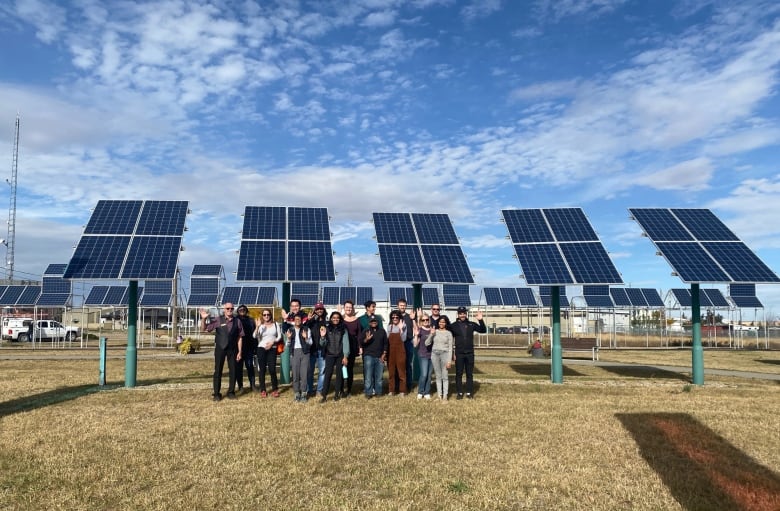
Growing up near Fort McMurray, Alta., Randall Benson started working in the oilsands like many of his family members. However, in the mid-1990s, the long hours and ecological impacts of the industry had him rethinking his occupation.
“I just found it counterintuitive to how I was raised to respect our environment, and so I made a decision to find something that was kind of the opposite,” said Benson, now 52.
The “opposite” turned out to be solar energy, which he learned about while flipping through a magazine after moving to Edmonton.
About 25 years later, Benson is pleased to see utility-scale solar projects booming — a welcome addition to the residential and community solar installations his company, Gridworks Energy, builds. Benson is working on a project commissioned by the Métis Nation of Alberta, of which he is a member, designed to generate enough power for 1,200 homes.
It’s part of a renewable energy boom in a province world-famous for its oil reserves.
There’s “almost gold rush-level activity for solar” in Alberta, said Sara Hastings-Simon, assistant professor at the University of Calgary and an expert in energy and climate policy. “The majority of solar that we have in the system in Alberta today was installed in 2021-2022. So this is a really very recent phenomenon.”
According to research by Hastings-Simon and colleagues, in 2021, renewables — solar, wind, and hydro combined — accounted for 14.3 percent of electricity on the Alberta grid, compared to less than three per cent in 2002. She expects that number to increase in 2022.
Hastings-Simon said multiple factors helped create the conditions for this growth in solar power.
Alberta and Ontario are the only Canadian provinces with deregulated wholesale energy markets. While a government with a regulated electricity market could decide to build renewables, Hastings-Simon said that a deregulated system allows for these projects to move forward because of open competition among energy suppliers and an easy route for companies to purchase renewable power directly.
The Alberta Electric System Operator is a not-for-profit organization that purchases power from an open market; the price of electricity changes hourly, set by supply and demand, Hastings-Simon said.
According to Natural Resources Canada, Alberta — in particular the south of the province — has great potential for solar power generation. Despite the vast resource and an open market, solar development was stuck in a bit of a “chicken-and-egg” situation, without anything to kick-start projects, said Hastings-Simon.
When NDP Leader Rachel Notley was premier, the province started a renewable electricity program, and while only wind projects were selected, it sent a message to corporate buyers that a renewable energy market was starting to take off in the province.
In 2018, the province put out a request for solar projects to power Alberta government facilities. This “helped to break that chicken-and-egg cycle,” said Hastings-Simon. The provincial government’s renewable energy procurement in turn sparked an “uptick in the interest of so-called non-utility procurement.”
In other words, instead of buying electricity from their utility, more companies and organizations are opting to work directly with renewable energy developers to secure electricity at a guaranteed price. This also works out well for renewable energy developers, who have to contend with variable rates when they sell power to the province.
For some companies, there was another incentive: under the federal carbon tax, solar can be used as an offset in order to comply with the cost of carbon pollution.
With the price of solar energy itself dropping, the effect was “the perfect storm” for a boom in solar development, said Hastings-Simon.
Much of the growth is happening in southern Alberta. That includes Canada’s largest solar farm to date, the Travers Solar Project in Vulcan County, which signed an agreement to sell electricity directly to Amazon.
The burst of solar activity has been welcome financially for Vulcan County. In recent years, some fossil fuel companies have walked away from properties, leaving outstanding tax bills unpaid, resulting in the county cutting its budget by 30 percent, said the county’s reeve, Jason Schneider.
According to Schneider, tax from renewable energy projects makes up 45 percent of the county’s revenue: about 25 percent of which is solar and 20 percent wind.
“It subsidizes everything,” he said. “It’s paying for libraries, it’s paying for roads, it’s paying for bridges.”
Hastings-Simon said the next hurdle the province may face will be keeping up with the capacity for solar projects to connect to the grid.
She points to Texas as an example of how to proceed. With lots of solar potentials, the state decided to “build transmission lines on the assumption that if we build it, developers will come and build renewable projects when they have that opportunity to interconnect [to the grid].”
When it comes to where public money can best be put to use to keep solar’s momentum going, she said transmission lines are “the biggest bang for the buck.”