A green machine: New Brunswicker uses solar to power his electric pickup truck
‘There’s probably going to be a huge demand in the future’
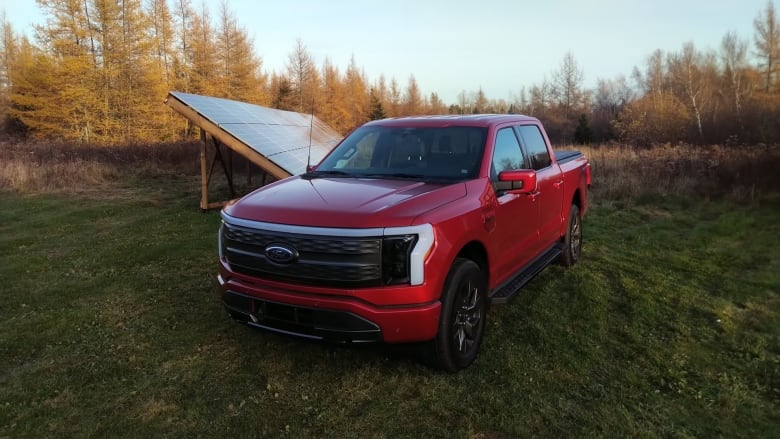
A future landscape for many might include an electric vehicle powered by a solar grid that can run electricity for a home when the power goes out.
But it’s not that futuristic for one New Brunswick man. In fact, it’s his reality.
Cory Allen, who lives in Nasonworth, N.B., switched to electric vehicles in 2019, beginning with an SUV.
He said he still had a gas car in the garage at the time because, like many people, he was skeptical.
More recently, he got an electric pickup truck, the Ford F-150 Lightning. He said it has some “really cool” features, including being able to “back feed” electricity into the house.
In the event of a power outage, Allen’s automatic standby generator would kick in, which he said would cost around $6 or $7 per hour to run.
But then he could go to the garage and flick a transfer switch that would allow the truck to power the house. He said the truck can power the house for around two days before needing a charge.

Not only that but the truck is charged using solar energy.
Allen had a 12.8-kilowatt array of solar panels installed that feed into the garage where vehicles are charged. He said the truck takes around eight hours to go from zero power to a full charge.
He said he went with a grid-tied solar system for his home, which is different than a standard setup, so there’s no battery component.
He said when the vehicles are charging, they will take all of the solar energy that’s being produced. But when they are not actively using all of the solar energy, the meter will run backward and the power will be banked for when they need it, Allen said.
His panels are on a wooden frame in the field by his house. That was more cost-effective than putting them on the roof of his home since the field has a better southern exposure, which means increased sunlight.
Not a lot of public knowledge
The idea for the setup originally came from Epic Energy, a New Brunswick solar energy company, when Allen approached them about a solar array.
“The electrician came over and we began talking and … he just offered so many of these awesome ideas,” said Allen.
Richard Knappe, president of Epic Energy, said there isn’t a lot of public knowledge about using solar to power electric vehicles, but they have had conversations with interested clients.
He said there also aren’t many vehicles that have the necessary technology.
“There’s probably going to be a huge demand in the future,” said Knappe. “But right now, we’re pretty limited to the F-150 Ford, and the Hyundai IONIQ 5.”
When it comes to setting up these types of systems, the wiring does get pretty complicated, he said. Knappe has an electrician who does this work, but he said it is hard to find electricians with that particular knowledge.
Long-term financial benefit
Allen said having an electric vehicle is also a long-term financial benefit for him.
He said the truck is expensive upfront at roughly $100,000. Then there is around $11,000 for the solar array and about $7,000 for the electrical work.
But the cost makes sense in the long run, Allen said.
He said as a small business owner who travels a lot, he was spending a lot on gas to fuel a pickup truck.
But without having to buy gas, he said his monthly payments come out to less since he’s only making payments on the truck.
Allen said one of the things that makes him feel good about his setup is the carbon footprint.
He said there is a heavy carbon footprint at the outset for the production of electric vehicles and solar panels. But, after using them for around five years, he said his household could be net zero.
He said environmental concerns are always something he tries to keep on top of his mind.
“I often joked, ‘Well, at least I’m offsetting the gas I put through the truck with the car,'” said Allen. “But now we have the electric car and the truck, so I don’t even have to worry about that joke anymore.”