String Inverters, Microinverters & Power Optimizers, What’s the difference?
Inverters are a key component of any solar panel system: while solar panels convert sunlight into electricity, inverters ensure that you can use the electricity they produce in your Home, RV, Boat, or cabin.
There are three primary inverter setups: string inverters, inverters + power optimizers, and microinverters. String inverters are the oldest, original technology: they are a proven, durable, and cost-effective option that has been installed for decades throughout the world. That said, microinverters and power optimizers are newer (but not new!) technologies and have been increasing in popularity over the last decade, especially in the residential market. In this article, we focus specifically on the capabilities of microinverters and compare that to the capabilities of adding power optimizers to a string inverter.
A note about power optimizers
Microinverters and power optimizers are comparable technologies – so comparable that some companies describe them as interchangeable (Never to do!) Both are collectively referred to as “Module-Level Power Electronics,” or MLPEs, but there are important differences between these setups that may make them more or less suitable for your installation.
Microinverters vs. power optimizers: compare and contrast
Microinverters and power optimizers are comparable technologies – so comparable that some companies describe them as interchangeable (but we would never!) Both are collectively referred to as “Module-Level Power Electronics,” or MLPEs, but there are important differences between these setups that may make them more or less suitable for your installation.
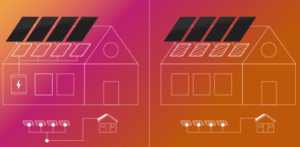
Similarities between microinverters and power optimizers
Let’s start off with the similarities between microinverters and power optimizers:
- Microinverters and power optimizers help improve performance for solar panels on complicated roofs, or roofs that experience marginal shading during the day.
- Both microinverters and power optimizers can monitor the performance of individual solar panels, meaning you can assess the number of kilowatt-hours (kWh) one solar panel in your array produces versus another.
- Typically, solar companies install one MLPE (i.e. microinverter or power optimizer) on the back of each individual solar panel. So, if your system has 20 solar panels, that often means 20 microinverters or 20 power optimizers.
Top 4 differences between microinverters vs. power optimizers
While microinverters and power optimizers provide many of the same benefits, the two technologies also have many differences, as explored in greater detail below:
1. Where direct current (DC) converts to alternating current (AC)
Microinverters convert DC energy into AC energy right at the panel site. While power optimizers are also located behind a solar panel, they don’t convert the electricity on their own; instead, optimizers “condition” the DC energy and send it to a central inverter that finishes the conversion process. The conditioning process fixes the voltage of the DC energy so that the centralized inverter can more efficiently convert it to AC energy.
2. Warranty
Both microinverters and power optimizers come with 25-year warranties. However, while optimizers are warrantied for 25 years, the centralized inverter that they pair with may have a shorter warranty. Installers often offer an extended warranty on the central inverter, either as part of their package deal or at an additional price.
Additionally, it’s important to take a close look at what’s included–and what’s not–in a company’s warranty terms. Does the company cover installation labor, replacement and the shipping of parts? And what is the claim process like for getting a warranty processed? All of these are important considerations when choosing the type of inverter to install on your property.
3. Maintenance
Over the lifetime of microinverters and power optimizer systems, you need to consider if and how many times they’ll fail, as well as the impact of an unlikely failure on the production of your solar panel system. In the event that an individual inverter fails, it will likely cost more to replace a microinverter or a power optimizer located on a roof than it will replace a string inverter on a wall at ground level, given the labor required to access and work on your roof.
However, that’s only part of the calculus around lifetime maintenance costs. The leading microinverters are warrantied for 25 years, whereas many string inverters are only warrantied for 12 years, implying that you might have to replace your inverter mid-way through the lifetime of your solar panels.
4. Battery options
Both microinverters and power optimizers are compatible with battery storage. However, depending upon whether you want a DC or AC coupled battery solution, you may need to use a particular type of inverter. If you’re considering battery storage, it’s a good idea to talk to your installer or electrician about which inverters work best with your battery of choice.
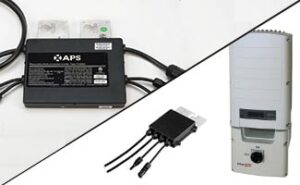
Microinverters vs. power optimizers: choosing the right option for your system
Microinverters and power optimizer systems have very similar efficiencies, are good for monitoring individual panel performance, and can help maximize energy production on slightly shaded or complicated roofs. But your preferences will ultimately determine which option is best for your home.
It’s important to keep in mind that microinverters and optimizers certainly aren’t the only options available – if you’re looking for the most economic option and have a south-facing roof with little shade, string inverters are the way to go.
String Inverters
String inverters are significantly larger than their aptly named counterpart. String inverters are roughly 3′ tall x 1.5′ wide x 1′ deep or approximately the same size as a water cooler. String inverters are typically mounted next to the electrical panel or can also be mounted outside. The major downside to string inverters is that shading on one solar panel can negatively impact the entire array (or string within the array).
Key Advantages:
- Most cost-effective inverter system
- Scalability for large/commercial solar arrays
String inverters should be used when:
- solar modules are mounted at the same pitch/azimuth
- a large-scale project is desired
- an unobstructed ground-mounted solar array is desired
Compare your inverter options to find the best match
As a consumer–and a shopper on EnergySage–you have the power to explore both your microinverter and power optimizer options. Start by reviewing the different manufacturers offering the two types of technologies, and then Contact Us – our team would be happy to provide you with no-obligation quotes that you can easily compare side-by-side to find the best solar panel system to fit your needs.
The Cost
String inverters are the most cost-effective but are only applicable in select circumstances. Because of string inverters’ selectivity, microinverters and DC optimizer systems are gaining market share.
Both microinverters and DC optimizers are fairly comparable in cost. If there is no room in your home or building for a string inverter, then micro may be more applicable. Similarly, if you are planning a large installation, DC optimizers’ scalability may give them the edge. Deciding a clear-cut winner between optimizers and micro inverts is a difficult task and one that can only be evaluated as the technology develops and inevitable corporate feuds ensue.
Additionally, the cost of various inverters’ may be impacted by CE Code rule changes and international trade issues (such as tariffs on one country or technology type).
Part of what we do at Power My Home is regularly evaluating what inverter systems are of the best quality and value for the given conditions. It is in everyone’s best interest to make sure you have the best product options at the lowest prices.
Thank you for sharing with us, I believe this website truly stands out : D.