Power My Home

  • Home
  • Services
  • About Us
  • Shop
  • Contact

No products in the cart.

Power My Home

  • Home
  • Services
  • About Us
  • Shop
  • Contact

No products in the cart.

  • Home
  • Services
  • About Us
  • Shop
  • Contact

Power My Home

Type To Search

Power My Home

  • Home
  • Services
  • About Us
  • Shop
  • Contact
Blog Post
Home electricity Different EV Charging Connector Types
electricityhybrid energyinnovationSolar Panel Companysolar panels

Different EV Charging Connector Types

February 2, 2022by powermyhome

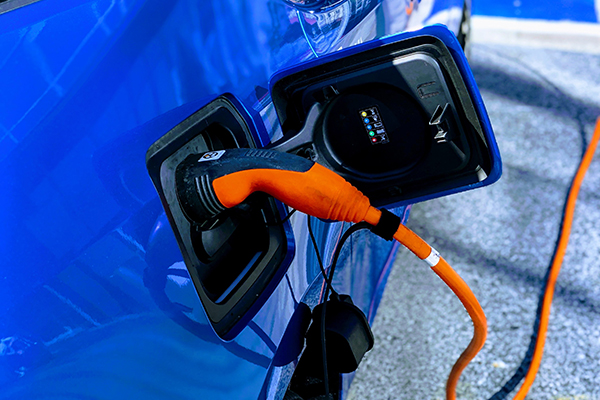
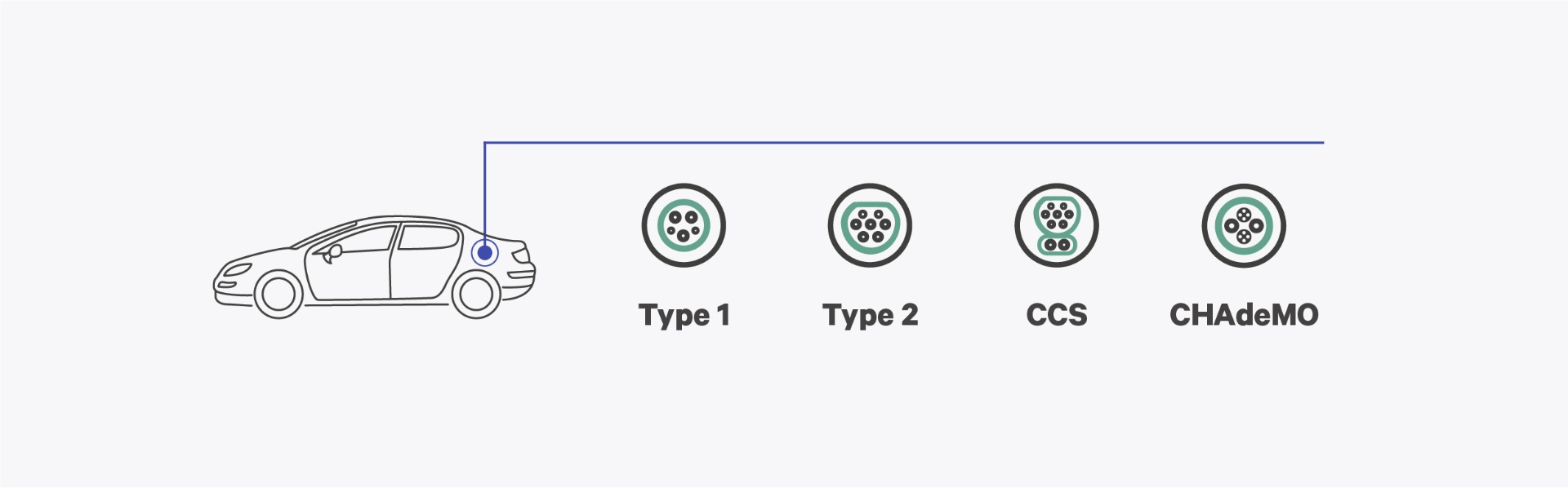
Whether you want to charge your electric vehicle at home, at work, or at a public station, one thing is essential: the outlet of the charging station has to match the outlet of your car. More precisely, the cable that connects the charging station with your vehicle has to have the right plug on both ends. Makes sense, right? Four types of plugs exist, two for alternating current (AC)  which allow charging up to 43 kW, and two for direct current (DC) which allows fast-charging up to 350 kW. 

Let’s start with AC. There are two types of AC plugs:

  • Type 1 is a single-phase plug and is standard for EVs from America and Asia. It allows you to charge your car at a speed of up to 7.4 kW, depending on the charging power of your car and grid capability. 
  • Type 2 plugs are triple-phase plugs because they have three additional wires to let current run through. So naturally, they can charge your car faster. At home, the highest charging power rate is 22 kW, while public charging stations can have a charging power up to 43 kW, again depending on the charging power of your car and grid capability.
electric car charging plugs

Two types of plugs exist for DC charging:

  • CHAdeMO: This quick charging system was developed in Japan, and allows for very high charging capacities as well as bidirectional charging. Currently, Asian car manufacturers are leading the way in offering electric cars that are compatible with a CHAdeMO plug. It allows charging up to 100 kW.
  • CCS: The CCS plug is an enhanced version of the Type 2 plug, with two additional power contacts for the purposes of quick charging. It supports AC and DC charging. It allows charging at a speed of up to 350 kW. 

type 1 and type 2 plugs
chademo and css plugs

In Europe, the type 2 AC charger, a triple-phase plug, is the standard and most charging stations have a type 2 outlet. But watch out, some charging stations have a fixed cable. An attached cable can make a lot of sense at places where you always charge the same car, like at home or at a fixed employee parking spot. It’s convenient because you don’t have to carry around a cable in your vehicle. Be aware that if you charge your car at a public charging station with a fixed cord, you’ll have to check if the attached cable fits into your car’s socket. in Europe and have a European car like the Renault ZOE, you can charge it at a public station using a charging cable with type 2 plugs at both ends (type 2 to type 2). The maximum speed might be up to 43 kW.

Now, what do you do if you live in Europe and drive an Asian car like the Nissan LEAF? Well, you need a cable that connects the type 2 plug of the charging station with the type 1 outlet of your vehicle (type 2 to type 1). The maximum speed will be up to 7.4 kW.
To summarize:

Four types of plug exist, two for AC (type 1 and 2) and two for DC (CHAdeMo and CCS).
Type 1 is common for American vehicles, it’s a single-phase plug and can charge at a speed of up to 7.4 kW.
Type 2 is standard for European and Asian vehicles from 2018 onwards, it’s a triple-phase plug and can charge at a level of up to 43 kW.
CCS is a version of type 2 with two additional power contacts. It allows very fast charging.
CHAdeMO can be found in Asian cars and allows for high charging capacities as well as bidirectional charging.
Related Link
Prev

String Inverters, Microinverters & Power Optimizers, What's the difference?

January 31, 2022

Solar panels: a ray of hope as UK energy prices go through the roof

March 1, 2022
Next

Related Posts

Read More
electricity
December 25, 2021by powermyhome

Best Deep Cycle Battery For Cold Weather

A deep cycle battery is imperative in a lot of situations but using them in extreme...
Read More
Solar Panel Company
December 22, 2020by powermyhome

Can Solar Panels Improve Your Home’s Value?

 Do Solar Panels Increase Property Value?Solar power is one of the most popular sources...

Comments (02)

  1. graliontorile
    March 7, 2022

    You are a very clever individual!

    Reply
    • powermyhome
      March 7, 2022

      Thank you very much!!

      Reply

Leave a Reply Cancel reply

Your email address will not be published. Required fields are marked *

Recent Posts
  • The Next Texas Energy Opportunity Is Already Built. Most Owners Just…
  • BC Hydro Signs Agreements for New Renewable Energy Projects at Lower Costs February 12, 2025
  • Request for Expressions of Interest for new power (FortisBC)
  • (FortisBC) is issuing a Request for Expressions of Interest (RFEOI) for additional power to meet its customers’ growing energy needs and support economic growth in B.C.
  • BC Hydro receives strong response to call for clean electricity to power economy
Recent Comments
  • Sam Jr on What are the advantages of a 48VDC over a 12VDC system?
  • powermyhome on What are the advantages of a 48VDC over a 12VDC system?
  • powermyhome on What are the advantages of a 48VDC over a 12VDC system?
  • Sam Jr on Advantages of Deep-Cycle Lithium Batteries for Utility Vehicles
  • Wilson Athanas on What are the advantages of a 48VDC over a 12VDC system?
Archives
  • May 2026
  • February 2025
  • December 2024
  • October 2024
  • August 2024
  • July 2024
  • June 2024
  • April 2024
  • February 2024
  • January 2024
  • December 2023
  • November 2023
  • September 2023
  • January 2023
  • October 2022
  • September 2022
  • July 2022
  • March 2022
  • February 2022
  • January 2022
  • December 2021
  • January 2021
  • December 2020
Categories
  • Backup Power Systems
  • BC Hydro
  • Boats & Trucks
  • Call For Power
  • Canada Greener Homes Loan
  • Commercial Solar
  • Deep Cycle Batteries
  • Electric Grid
  • electricity
  • Energy Economics
  • EV Chargers
  • FortisBC
  • Green Energy Development
  • Grid-tie Solar
  • hybrid energy
  • hydrogenium
  • Independent Power Producers
  • innovation
  • LiFePO4
  • Micro-Grid
  • Off-Grid
  • Power N Go
  • Royer Batteries
  • RV's
  • RV's & Campers
  • Solar Farm
  • Solar Panel Company
  • solar panels
  • Uncategorized
  • Utility Scale
  • Vanadium Redox Flow Battery
Tags
EV Charging LiFePO4

POWER MY HOME

Facebook-f Google Instagram

Contacts

1288 W Cordova St, Vancouver, BC V6C 3R3

[email protected]

(778) 651-5255 OR (613) 262-4799

Subscribe

Subscribe to our newsletter!
Stay always in touch!

    * Don't worry, we don't spam.

    Copyright ÂĐ 2024 Power My Home All Rights Reserved

    Top